
Yesterday I found myself discussing claims about the origins of Israel’s God with my son. He seemed to regard the essential theory as accepted among scholars. He had also discussed it with his priest, who apparently regarded it as something everyone already knew.
The claim itself was far from new to me. I first encountered it around seventeen years ago, when I began engaging in religious forums online. I was debating a humanist who appealed, if my memory serves me correctly, to Richard Elliott Friedman. Friedman was not the founder of the Documentary Hypothesis, although his work brought a modern version of it before a large popular audience. Whatever source my opponent was using, the essential argument was familiar: the different divine names in the Pentateuch betrayed different sources and an earlier history lying behind the Bible’s finished account.
What was new was hearing the subject return through my son, not as an old forum argument but as something apparently too well established to require much defence. It made the question personal. Had I spent so long within conservative evangelical circles that I had become enclosed within an echo chamber? Had critical scholarship discovered something important while I was reading only people who already agreed with me?
That possibility should not be dismissed merely because it is uncomfortable. Commitment to the truth is commitment to God. If evidence requires me to correct my understanding of Scripture, loyalty to God cannot mean refusing to look at it. But the same commitment also requires that claims carrying the authority of scholarship be examined carefully. A reconstruction does not become an archaeological fact because it has been repeated confidently or taught widely.
The reconstruction in question tells the religious history of Israel in approximately this way. The patriarchs originally worshipped the Canaanite high god El. Yahweh was a separate deity from the southern wilderness—perhaps Midian, Edom or Seir—whose worship was later brought into Israel. Over time, the two gods were identified with one another. Yahweh absorbed El’s titles, took his position at the head of the divine council and eventually emerged as the only God of a fully developed Israelite monotheism.
For many readers, this is not offered as one disputed reconstruction among others. It is treated as something scholarship has discovered and informed people simply know.
The genuine evidence behind the theory deserves serious attention. El was both a common Semitic word for deity and the designation of the high god in Canaanite religion. Israel lived within a wider Canaanite cultural world. Several ancient biblical poems describe Yahweh as coming from Sinai, Seir, Paran or Teman. Israelite and Judahite inscriptions attest forms of worship condemned by Scripture, including the notorious references to “Yahweh and his asherah.” Exodus itself says that the patriarchs knew God as El Shaddai but were not acquainted with Him by the name Yahweh in the manner revealed to Moses.
None of that should be concealed. Scripture does not need protection from evidence.
But evidence must be distinguished from the historical story constructed from it. Archaeology has not uncovered two gods being combined. No inscription announces that Yahweh was formerly a son of El and has now taken his throne. No recovered Israelite creed records the transition from El-worship to Yahweh-worship. The proposed merger is an attempt to connect scattered linguistic, textual and archaeological observations into an unwritten prehistory.
The question is not whether that reconstruction can be imagined. The question is whether the evidence requires it—or whether the Bible itself supplies a coherent and historically serious account of the same facts.
Three Claims Commonly Confused
Three related but distinct theories are frequently bundled together.
The first is the classical Documentary Hypothesis, according to which the Pentateuch was composed from sources conventionally designated J, E, D and P. The supposed Elohist source, E, was named for its use of Elohim before the revelation of the name Yahweh.
The second is the southern-origin hypothesis, which proposes that Yahweh was originally worshipped somewhere south of Canaan and subsequently introduced into Israel.
The third is the El–Yahweh merger hypothesis, which argues that El and Yahweh began as distinct deities and were later identified.
Acceptance of one does not logically require acceptance of all three. Indeed, the continuous Elohist source has long been among the most disputed elements of the classical Documentary Hypothesis. Many critical scholars have reduced E to fragments, reassigned its passages to other layers or abandoned it altogether, while a newer documentary school has attempted to reconstruct it on different grounds. There is no simple contemporary consensus that four neatly recoverable documents were stitched together in the manner once taught as JEDP.
Likewise, an association between Yahweh and the southern wilderness does not by itself establish that He originated there as a local god. A place may mark the beginning of a people’s knowledge of a mighty act without marking the beginning of the One who performed it.
El: A Word, a Title and a Possible Ambiguity
The Hebrew El belongs to the common religious vocabulary of the Semitic world. It can mean “god” or “God.” It could also function as the designation of the high god known from Canaanite and Ugaritic religion. Elohim is similarly flexible: depending upon its grammar and context, it may designate the God of Israel, gods, heavenly beings or other occupants of the spiritual world.
That ambiguity is real, but it cannot decide the identity of the one being named.
English-speaking Christians, Muslims and Hindus may all use the word God while intending radically different conceptions of the divine. Arabic-speaking Christians and Muslims both use Allah. A common noun does not guarantee a common referent, still less an identical theology.
Israel did not need to invent a previously unknown noun before it could confess the true God. Revelation ordinarily speaks through existing human language, correcting its content and identifying its proper object. The important question is therefore not merely whether Israelites and Canaanites used the word El. It is what character, works and identity Israel’s revelation attributes to Him.
Genesis supplies an unusually explicit example. Melchizedek blesses Abraham in the name of El Elyon, “the most high God, possessor of heaven and earth” (Genesis 14:18–20). Abraham then replies:
“I have lift up mine hand unto the LORD, the most high God, the possessor of heaven and earth.”
Genesis 14:22
The Hebrew identification is direct: YHWH, El Elyon. A title that could conceivably be used differently by another worshipper is given its proper referent. The Most High whom Abraham confesses is Yahweh, possessor of heaven and earth.
Critical reconstruction can designate YHWH in this verse a later editorial identification of two formerly separate gods. But notice the method. A text distinguishing the titles is treated as evidence of an early separation; a text identifying them is treated as evidence of a later merger. The theory thereby absorbs both difference and identity as confirmation of the same developmental history.
That does not make the theory impossible. It does mean that the theory is not simply being read from the surviving text.
One God, Many Memorials
Scripture frequently joins El or YHWH to a description of God’s character. Some expressions are titles God declares; others arise as memorial confessions after an encounter.
El Elyon is God Most High. El Olam is the everlasting God. El Roi is the God who sees, the name Hagar gives to Yahweh after He finds her in affliction (Genesis 16:13). El Shaddai, traditionally rendered “God Almighty,” is God’s patriarchal designation in passages concerned with covenant promise, fruitfulness and His power to accomplish what appears impossible. The exact etymology of Shaddai remains disputed, so more should not be claimed than the contexts warrant.
The memorial pattern is especially clear in expressions formed with Yahweh’s covenant name.
After God provides the ram in Isaac’s place, Abraham names the location YHWH-jireh: “the LORD will provide,” or “the LORD will see to it” (Genesis 22:14). After victory over Amalek, Moses calls his altar YHWH-nissi, “the LORD is my banner” (Exodus 17:15). After Gideon is assured that he will not die from his encounter, he calls his altar YHWH-shalom, “the LORD is peace” (Judges 6:24).
These are not the remnants of provider, warrior and peace deities being absorbed into a growing composite god. The one God acts, His people recognise something true of His character, and the memorial preserves the revelation.
The same principle applies even where no formal compound name is created. Canaanites credited Baal with rain and agricultural fertility. Scripture does not respond by conceding that sphere to Baal. Yahweh declares:
“For she did not know that I gave her corn, and wine, and oil…”
Hosea 2:8
This need not be Yahweh absorbing Baal’s agricultural function. It is revelation dispossessing the idol of stolen glory. The rain was never Baal’s to give.
The multiplication of divine descriptions records the unfolding recognition of one God’s inexhaustible character. Israel’s memorial names preserve the places where promise became experience and divine character became memorable history.
Did the Patriarchs Know Yahweh?
Exodus 6:2–3 presents the most obvious difficulty:
“I am the LORD: And I appeared unto Abraham, unto Isaac, and unto Jacob, by the name of God Almighty, but by my name JEHOVAH was I not known to them.”
If the patriarchs did not know the name Yahweh, why does Genesis use it repeatedly? Abraham invokes Yahweh, speaks to Yahweh and calls the place of Isaac’s deliverance YHWH-jireh. Is this evidence that one source knew the name while another believed it was first revealed to Moses?
The answer is found within Exodus’s own use of the verb “to know.” Pharaoh hears the divine name and replies:
“Who is the LORD, that I should obey his voice to let Israel go? I know not the LORD.”
Exodus 5:2
Pharaoh’s ignorance is not phonetic. He has just heard the name. He does not recognise Yahweh’s identity and authority.
God then promises:
“And the Egyptians shall know that I am the LORD, when I stretch forth mine hand upon Egypt.”
Exodus 7:5
Egypt will know Yahweh through His acts of judgment. Israel will know Him through redemption. The name is made known in the biblical sense when the character and power belonging to it are manifested in history.
The patriarchs received the covenant largely as promise. The Exodus generation would experience Yahweh bringing Abraham’s family out of bondage as a nation, judging its oppressor, dwelling among it and leading it towards the promised inheritance. They would know in fulfilment what the fathers had known in anticipation.
Most importantly, Exodus does not introduce Yahweh as an unrelated deity:
“I am the God of thy father, the God of Abraham, the God of Isaac, and the God of Jacob.”
Exodus 3:6
After revealing His name, He repeats:
“The LORD God of your fathers, the God of Abraham, the God of Isaac, and the God of Jacob…hath sent me unto you: this is my name for ever.”
Exodus 3:15
Exodus 6 deliberately makes the same identification: “I am YHWH,” and it was He who appeared to Abraham, Isaac and Jacob as El Shaddai. The narrative does not describe the replacement of the fathers’ God. It reveals the covenant name of the very God who made the promises now being fulfilled.
A Feast to Yahweh Before a Golden Calf
The Bible itself gives us a controlled demonstration that retaining Yahweh’s name does not guarantee faithful knowledge or worship of Yahweh.
When Aaron makes the calf, the people attribute the Exodus to it. Aaron then proclaims:
“To morrow is a feast to the LORD.”
Exodus 32:5
The feast is expressly announced in the name of YHWH. Israel attaches the correct covenant name and the correct saving event—deliverance from Egypt—to an idolatrous representation.
This distinction matters profoundly when interpreting archaeology. An inscription connecting Yahweh with a goddess, image, local shrine or forbidden ritual establishes that someone practised a corrupt form of Yahwism. It does not establish that the corruption belonged to the original identity of Yahweh and was removed only by later biblical theologians.
The religion practised by Israelites must not automatically be equated with the religion revealed to Israel.
Scripture does not portray Israel’s history as a steady ascent from innocent polytheism towards ethical monotheism. It portrays a people who receive revelation and repeatedly corrupt it: the calf at Sinai, Baal and Ashtaroth in the period of the judges, Jeroboam’s calves, Ahab’s Baal cult, Manasseh’s desecration of the temple, the Queen of Heaven in Jeremiah and the abominations shown to Ezekiel within the sacred precincts.
Archaeological evidence of Israelite syncretism is therefore not an embarrassment suppressed by the Bible. It is evidence of the very religious world prosecuted by its prophets.
The God Who Marched from Sinai
Several ancient poems describe Yahweh as coming from the south. These passages form an important part of the southern-origin hypothesis, but their contexts describe the origin of a memorable saving act rather than the origin of the divine being.
Deborah and Barak sing:
“LORD, when thou wentest out of Seir, when thou marchedst out of the field of Edom, the earth trembled, and the heavens dropped, the clouds also dropped water. The mountains melted from before the LORD, even that Sinai from before the LORD God of Israel.”
Judges 5:4–5
This is a victory hymn following the defeat of Sisera. Yahweh is the divine warrior who marches to rescue His people. The ancient Sinai theophany supplies the pattern for His present intervention: creation trembles, the heavens pour, the stars fight and the Kishon sweeps the enemy away. Sisera’s chariot supremacy is broken by the Lord of creation.
Psalm 68 interprets the imagery:
“O God, when thou wentest forth before thy people, when thou didst march through the wilderness; Selah: The earth shook, the heavens also dropped at the presence of God: even Sinai itself was moved at the presence of God, the God of Israel.”
Psalm 68:7–8
God marches from the wilderness because He went before His people there.
Deuteronomy 33:2 makes the Sinai setting clearer still:
“The LORD came from Sinai, and rose up from Seir unto them; he shined forth from mount Paran, and he came with ten thousands of saints: from his right hand went a fiery law for them.”
This is the introduction to Moses’ blessing of Israel. The language of coming, dawning and shining depicts Yahweh’s glorious manifestation. The verse itself identifies the event: He comes with His holy ones and gives His law. The following lines celebrate His love for the people and His kingship in Jeshurun.
Habakkuk deliberately carries the same memory into a new crisis:
“God came from Teman, and the Holy One from mount Paran…His glory covered the heavens, and the earth was full of his praise.”
Habakkuk 3:3
Habakkuk has prayed, “revive thy work” and “in wrath remember mercy” (3:2). He sees Yahweh going forth “for the salvation of thy people” (3:13) and walking through the sea (3:15). Sinai, Exodus, conquest and future deliverance are woven into one divine-warrior vision. The prophet’s hope is that the God who came then will come again.
“Coming from” a location does not mean originating there. Isaiah sees the divine judge coming from Edom and Bozrah after executing judgment (Isaiah 63:1–6); no one therefore concludes that Yahweh was born as the local god of Bozrah. Geography identifies the theatre of divine action and the direction from which the deliverer appears.
These passages may properly be called southern theophanies: manifestations of Yahweh’s glory and power associated with Sinai and His wilderness march. Christian interpreters have often understood particular manifestations—especially the Angel of the LORD—as appearances of the pre-incarnate Son. That christological identification may be warranted in passages where the messenger bears the divine name, speaks as God and receives reverence. Nevertheless, the present argument requires only the broader term theophany. Every Christophany is a theophany, but not every theophany should be identified confidently as a Christophany.
The critical reconstruction reverses the literary movement. It treats the Exodus and Sinai account as a later explanation of an older memory belonging to a southern territorial god. But that conclusion arises only after the explanation repeatedly supplied by the texts has been set aside.
The undisputed observation is modest: ancient Israel remembered Yahweh as manifesting His glory and marching from the southern wilderness. The biblical explanation is plain: Sinai was the place of covenant revelation, and the wilderness was the route of the God who went before Israel. The claim that Yahweh therefore originated as a southern tribal deity is a further reconstruction.
Was Yahweh One of El’s Sons?
Deuteronomy 32:8–9 is frequently presented as a surviving fragment from the period before Yahweh and El were identified. The Masoretic Text reads “according to the number of the children of Israel,” while important older witnesses support a reading such as “sons of God” or “divine beings.” That older reading deserves to be taken seriously.
The passage then reads approximately:
“When the Most High divided to the nations their inheritance, when he separated the sons of Adam, he set the bounds of the people according to the number of the sons of God. For the LORD’S portion is his people; Jacob is the lot of his inheritance.”
The merger theory reads Elyon, the Most High, as the Canaanite El distributing nations among his divine sons, with Yahweh receiving Israel as his assigned portion.
But the text never calls Yahweh a son of Elyon. That relationship must be supplied. The passage can equally describe the Most High assigning the nations under subordinate heavenly powers while reserving Israel as His own peculiar portion.
Elsewhere biblical poetry explicitly identifies Yahweh as the Most High:
“For the LORD most high is terrible; he is a great King over all the earth.”
Psalm 47:2
“That men may know that thou, whose name alone is JEHOVAH, art the most high over all the earth.”
Psalm 83:18
The parallelism of 2 Samuel 22:14 is equally transparent:
“The LORD thundered from heaven, and the most High uttered his voice.”
Nor does the existence of a divine council require Yahweh to have developed from one member into its head. Scripture can affirm a populated spiritual world without surrendering the unique identity of its Creator. Psalm 82 depicts Elohim judging among the elohim. The same word functions differently within a single verse because the presiding God and the beings judged by Him do not belong to the same order.
The “sons of God” reading may enlarge our understanding of the biblical supernatural world. It does not require a genealogy in which Yahweh is one of El’s offspring.
The Merger Nobody Has Excavated
Archaeology is an indispensable secondary witness. It places Israel within its ancient environment and prevents romantic accounts in which every Israelite faithfully observed the covenant. But archaeological remains must be allowed to say exactly what they say—and no more.
The Shasu inscription may not name a god
Egyptian geographical lists from Soleb and Amarah West mention something conventionally rendered “the land of the Shasu of yhw.” This is often popularised as the earliest archaeological reference to Yahweh-worshipping Midianite nomads.
The identification is possible, but the inscription contains no prayer, image, offering or narrative concerning a deity. It does not mention Israel, Moses or Midian, and yhw may designate a people or territory. Daniel Fleming accepts that the name is probably related to the later Yahweh but argues that it may not originally have been divine at all. His treatment specifically challenges the simple model in which Israel borrowed an outsider’s desert god.
Even the stronger identification would remain compatible with the biblical account: Moses encountered Yahweh in the southern wilderness, and Israel’s foundational revelation occurred at Sinai.
The earliest certain external Yahweh is already Israel’s God
The ninth-century Mesha Stele contains the earliest generally accepted extra-biblical reference to Yahweh as Israel’s deity. King Mesha of Moab boasts that he took vessels belonging to YHWH from an Israelite sanctuary and presented them before Chemosh.
At the first point where the external record becomes certain, Yahweh is already recognisably Israel’s God and is distinguished from Moab’s Chemosh. The inscription preserves no memory of Yahweh as El’s son, rival or recent replacement.
That cannot prove what happened centuries earlier. It does, however, expose a large evidential gap. The Merneptah Stele places a people called Israel in Canaan around 1208 BC, but it does not name Israel’s God. The proposed El–Yahweh transition is located largely between that reference and the later direct Yahweh inscriptions—a period for which no inscriptional sequence documents the merger.
Ugarit supplies analogy, not ancestry
The Ugaritic tablets illuminate a Northwest Semitic pantheon containing El, Athirat, Baal, Anat, Yam and Mot. They are essential comparative evidence. Yet Ugarit was a particular Late Bronze Age city well north of Israel, not the spokesman for an identical religion practised in every Canaanite settlement.
Yahweh is not securely attested as a member of the Ugaritic pantheon. No Ugaritic text identifies Him as El’s son or describes His transfer into Israel. Similar titles and poetic images demonstrate a shared linguistic and cultural world; they do not by themselves establish a line of religious descent.
An El-name cannot resolve whom El denotes
The name Israel contains the element El. This is sometimes treated as evidence that Israel worshipped the Canaanite El before adopting Yahweh. But because El can mean simply “God,” the name cannot tell us whether its users intended the Ugaritic high god, a generic divine designation or Yahweh described as God.
The biblical name Elijah—Eli-yahu, “my El is Yahweh”—shows how naturally the title and personal name can be identified. Onomastics can reveal religious language, but an El-element alone cannot recover its complete theology.
Kuntillet Ajrud is later and less tidy than its publicity
The inscriptions from Kuntillet Ajrud, usually dated to the ninth or eighth century BC, include blessings associated with “Yahweh of Samaria,” “Yahweh of Teman” and “his asherah.” They are important evidence for local and syncretistic Yahwism.
They are not, however, a photograph of Israel’s religious beginnings. Their date places them within the divided monarchy, the very world in which the biblical writers describe calf worship, Baalism, high places and continual covenant infidelity.
The expression translated “his Asherah” remains disputed. It may refer to the goddess, a cultic object or symbol associated with her, or a local sacred installation. The familiar drawings on one jar cannot simply be labelled Yahweh and His wife: specialists have instead identified the prominent figures as forms of the Egyptian dwarf deity Bes, and the relationship between the drawings and inscriptions is uncertain.
Even if a writer at Kuntillet Ajrud believed Yahweh possessed a divine consort, the conclusion would be that some Israelites held that belief. It would not follow that Asherah belonged to Yahweh’s original identity before later reformers removed her.
Durable disobedience survives
Judahite pillar figurines and other household religious objects provide extensive evidence of popular practice, particularly during the eighth to early sixth centuries BC. Their precise identities and functions remain debated. What is not debatable is that a large portion of the material commonly used to illustrate Israel’s primitive polytheism belongs to the later monarchy—the period in which Scripture itself describes intense syncretism.
Archaeology naturally recovers durable figurines, amulets, altars, graffiti and cult objects. Spoken confessions vanish. Wooden scrolls decay. An idol buried in a house may survive when the prophetic sermon condemning it does not.
This creates an evidential imbalance. Archaeology is often better equipped to uncover popular practice than normative revelation. Counting surviving objects cannot determine which belief came first or which Israel understood as covenantally authoritative.
The same excavated evidence can therefore occupy the middle of two very different histories:
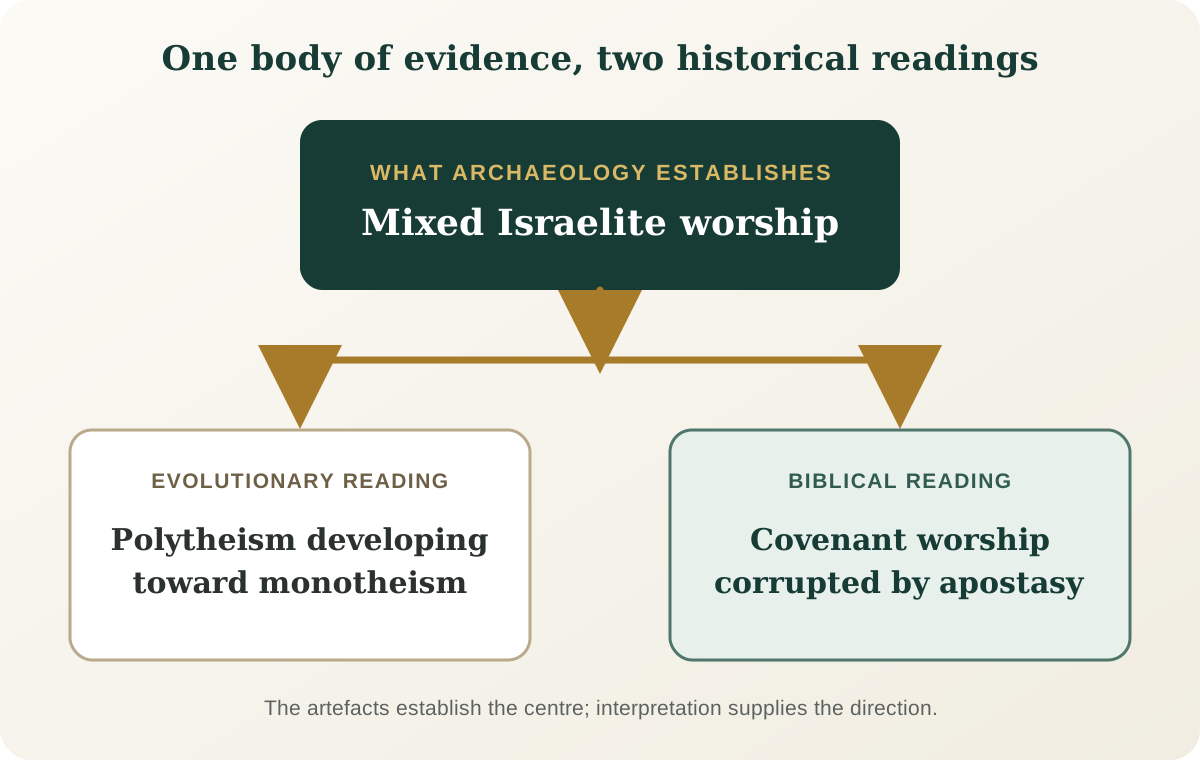
Archaeology establishes mixed Israelite worship. The direction of theological movement depends upon the historical framework brought to that evidence.
Archaeology establishes the middle box. It cannot, without further assumptions, supply the direction of theological movement.
There are even archaeological features that complicate a uniform evolutionary story. Recognisable anthropomorphic representations of Yahweh are difficult to identify securely, and the extent and antiquity of Israelite aniconism remain debated. At early Khirbet Qeiyafa, excavators found cult rooms, altars, standing stones, libation vessels and shrine models but reported no human or animal images in the cultic assemblage. The site’s ethnic identity and interpretation should not be overstated, but it prevents the archaeological record being reduced to an uninterrupted progress from image-filled Canaanite polytheism to late aniconic Yahwism.
Material continuity with Canaan also proves less than is sometimes supposed. Related pottery, language, architecture and agricultural practices make it likely that many early Israelites arose within the land’s existing population. They cannot tell us whom a potter understood El to be. Cultural continuity does not exclude an Exodus group joining highland communities, covenantal reorganisation, conversion to Yahweh or a mixed people receiving a new national identity.
The “El plus Yahweh equals the later biblical God” model is one way of organising the evidence. It is not itself an excavated object.
When Reconstruction Becomes Resistant to Correction
Historical reconstruction is unavoidable. Every account of antiquity draws inferences from incomplete evidence. The danger begins when the reconstruction becomes difficult to falsify.
Within the merger model:
- passages distinguishing divine titles can be classified as remnants of originally separate gods;
- passages identifying those titles can be classified as later editorial fusion;
- monotheistic texts can be dated late because their theology is considered developed;
- and monotheism can then be declared late because the monotheistic texts have been dated late.
Likewise, the Exodus narrative may be treated as a late explanation of southern Yahweh traditions, after which the southern traditions are presented as evidence against the historical explanation supplied by Exodus.
This does not demonstrate that every critical judgment is mistaken. It shows why the final picture may appear more certain than its foundations permit. Once the canonical explanation is automatically treated as secondary, the surviving text is allowed to testify only after being reconstructed into something else.
The proper response is not hostility towards scholarship. It is disciplined attention to the difference between observation and inference:
- El is both a generic word and a Canaanite divine designation: fact.
- Israel shared much of Canaan’s language and material culture: fact.
- biblical poetry associates Yahweh’s manifestation with the southern wilderness: fact.
- many Israelites practised polytheistic or syncretistic religion: fact.
- Yahweh was originally a separate southern god who entered Israel and merged with El: reconstruction.
The reconstruction may be argued. It must not be smuggled into the discussion under the label of archaeology.
The Biblical Alternative
The Bible’s own account explains the evidence without requiring the invention and combination of gods.
The true God could be called El because El was ordinary Semitic language for God. The same word could be misapplied to false conceptions without compromising its truthful use. The God known to the patriarchs as El Shaddai disclosed the covenantal fullness of His name YHWH through the Exodus. He manifested His glory at Sinai, went before Israel through the wilderness and fought for His people. The geographical memory of His southern march became the poetic pattern for later acts of deliverance.
Israel then repeatedly corrupted His worship while retaining His name. The golden calf supplies the pattern in the first generation: an idolatrous image, the Exodus attributed to it, and a feast proclaimed to YHWH. Later inscriptions and cult objects show the same tragic capacity for mixture. The prophets did not gradually manufacture a new God from those practices. They summoned Israel back to the God who had already revealed Himself.
The similarities between biblical descriptions of Yahweh and the claims made for surrounding gods may likewise function as polemic rather than merger. Rain does not belong to Baal. The sea does not belong to Yam. Creation and eternity do not belong to the Canaanite El. The stars are not gods to be worshipped. Every realm belongs to Yahweh, who made heaven and earth and judges the powers within them.
This alternative does not deny progressive revelation. Israel’s knowledge of God deepens as His purposes unfold. But progressive revelation is not the same as divine evolution. God’s people come to know more fully who He eternally is; He does not become the true God by accumulating the attributes of His defeated rivals.
The God of Abraham Has a Name
The issue is not whether Scripture can survive historical investigation. It is whether Scripture will be permitted to give evidence concerning its own history before a hypothetical prehistory behind it is declared factual.
There is no need to deny the difficult material. Israel was culturally situated in the ancient Near East. Its language was shared. Its people were frequently unfaithful. Its poets remembered Yahweh marching from the south. Its archaeological remains expose forms of compromised worship that no defender of biblical inerrancy is required to defend.
But none of this establishes that the living God was assembled from the ruins of a pantheon.
Scripture’s confession is neither confused nor reluctant. The God who appeared to Abraham, Isaac and Jacob is the God who spoke to Moses. The God who revealed Himself as El Shaddai is YHWH. The One who descended upon Sinai marched before His people, judged Egypt, defeated their enemies and brought them towards their inheritance. He is not one local power among others but “the most high over all the earth.”
What deserves resistance is not historical investigation, but the ease with which an uncertain reconstruction can acquire the authority of revelation and then be introduced as something everyone knows.
The biblical alternative is not a frightened retreat from inconvenient evidence. It takes the linguistic facts, the southern theophanies, the textual difficulties and the archaeological remains seriously. It simply refuses to make them say more than they do.
The merger theory has explanatory power, but it has not excavated a merger. The Bible supplies another history: revelation, redemption, remembrance and apostasy. That history deserves to be heard in its own voice.
And its voice is clear:
“I am the LORD thy God from the land of Egypt, and thou shalt know no god but me: for there is no saviour beside me.”
Hosea 13:4
Notes and Sources
- Richard Elliott Friedman is a prominent contemporary defender of the Documentary Hypothesis and author of Who Wrote the Bible? and The Bible with Sources Revealed. Jean Astruc, Johann Eichhorn, Hermann Hupfeld, Karl Heinrich Graf, Abraham Kuenen and Julius Wellhausen belong to the theory’s much longer development. See Friedman’s own summary of current documentary theory.
- For the unsettled state of the Elohist question, see Jan C. Gertz, “Genesis in Source and Redaction Criticism Today”, and Joel S. Baden, “The Re-Emergence of Source Criticism”.
- On the flexibility of the terms El and Elohim, see Mark S. Smith, The Early History of God, 2nd ed. (Eerdmans, 2002), and the Society of Biblical Literature’s “Names of God”.
- The traditional “Almighty” conveys the contextual force of Shaddai, but its etymology is unsettled. See Heath D. Dewrell, “The Etymology of Šadday,” Vetus Testamentum 69 (2019): 212–238.
- A Christophany is understood as a temporary manifestation of the pre-incarnate Son; in the incarnation the Word permanently assumes a complete human nature (John 1:14). The article’s historical argument depends only upon divine manifestation, not upon settling the personal identity of every Old Testament appearance.
- The Dead Sea Scrolls and Septuagintal evidence favour a reading involving divine beings in Deuteronomy 32:8. See the fragment in the Israel Antiquities Authority’s Leon Levy Dead Sea Scrolls Digital Library.
- Daniel E. Fleming, Yahweh before Israel (Cambridge University Press, 2021), especially “Yhw of Shasuland” and “The Midianite Hypothesis”.
- For the Mesha Stele and its reference to vessels of YHWH, see “What Does the Mesha Stele Say?”.
- For the disputed language and drawings at Kuntillet Ajrud, see “Puzzling Finds from Kuntillet ‘Ajrud”.
- Judahite pillar figurines are especially associated with the eighth to early sixth centuries BC, and their identity and function remain disputed. See “Judean Pillar Figurines”.
- Khirbet Qeiyafa should be used cautiously because the site’s ethnic identification and the interpretation of its finds are debated. See “Evidence of Cultic Activity in Judah Discovered at Khirbet Qeiyafa”.