
“This day have I begotten thee” appears to be applied to Christ’s resurrection. Did Jesus become the Son of God when He rose—or does Scripture distinguish His eternal Sonship from His resurrection, enthronement and saving work within history?
---
More than twenty years ago, during the early part of my Christian walk, one sentence in Scripture troubled me:
“Thou art my Son, this day have I begotten thee.”
Psalm 2:7; Acts 13:33
Acts appeared to connect this “begetting” with Christ’s resurrection. That raised an obvious question. If Jesus was begotten when He rose from the dead, did He only then become the Son of God? Yet John called Him God’s “only begotten Son” before the cross and presented Him as the eternal Word who was already with God in the beginning.
I knew those truths could not contradict one another, but I did not yet possess the theological distinction that would later help me considerably: the distinction between eternity and economy.
So I tried to work the problem out from the text. I wrote three Strong’s numbers across a scrap of lined paper:
- gennaō — G1080
- monogenēs — G3439
- prōtotokos — G4416
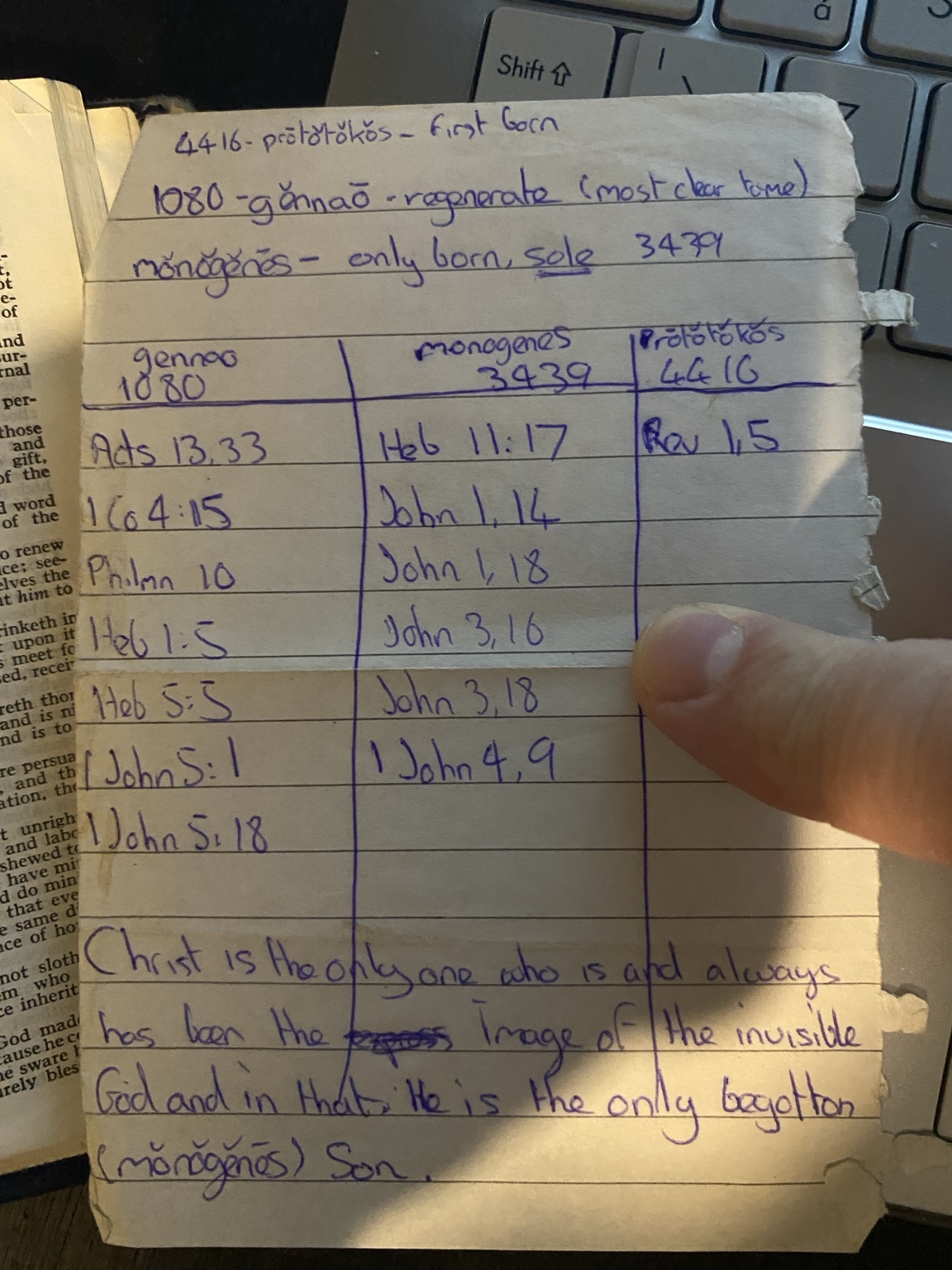
My original word study from the early years of my Christian walk. I had identified the textual problem before I possessed the theological vocabulary needed to resolve it.
Under each heading I began listing every passage I could find. I was trying to discover whether Scripture was describing one event in three different ways or using related language for distinct truths. In particular, I wanted to know whether resurrection was the begetting of Christ—and, if so, in what sense.
The notes were elementary, but the method remains sound: notice a distinction, trace the words through Scripture, compare their contexts, and allow the whole testimony of Scripture to govern the conclusion.
The mature form of that method requires one further discipline. A concordance can show us where an English word occurs, and a lexicon can show us the range of a Greek word, but neither can interpret a verse for us. Words receive their precise force from sentences, arguments, books and ultimately the canon as a whole. We must therefore ask not merely, “What can this word mean?” but, “What is the inspired writer saying with it here?”
That distinction matters greatly in the doctrine of Christ. The answer is not that Acts 13 has nothing to do with resurrection. The answer is that resurrection belongs to the Son’s saving mission within history; it does not mark the beginning of His eternal identity.
Eternity and economy
In Christian theology, the eternal or immanent Trinity refers to who the Father, Son and Holy Spirit eternally are in God’s own being. The economy of salvation refers to how the three divine persons act toward creation and within history to accomplish redemption.
The distinction does not divide God into two Trinities. Nor does it imply that God merely wears three temporary masks. The same eternal Father sends, the same eternal Son is sent and becomes incarnate, and the same eternal Spirit applies the work of Christ. The economy reveals the eternal persons, but events within the economy do not bring those persons into existence.
This gives us a crucial rule for reading Christological texts:
What happens to the incarnate Son in the history of redemption must not automatically be treated as the origin of the eternal Son in the being of God.
The Son is born of Mary in the economy; He does not thereby begin to exist as the eternal Son. He is declared and installed as the Messianic Son-King through resurrection in the economy; He does not thereby acquire divine Sonship. He receives authority, glory and inheritance as the obedient incarnate Messiah in the economy; He never lacked divine authority or glory in eternity.
Without this distinction, biblical statements can appear to conflict. Christ already possesses glory with the Father before the world exists (John 17:5), yet after His obedience unto death God “highly exalted him” (Philippians 2:9). He is already the Son whom the Father sends (Galatians 4:4), yet at resurrection He is “declared to be the Son of God with power” (Romans 1:4). He creates and upholds all things (Colossians 1:16–17), yet as the risen man He receives universal dominion (Matthew 28:18).
The contradiction disappears when we ask the right question. Is the passage describing who the Son eternally is, or what the incarnate Son becomes, receives or accomplishes as Mediator within the divine economy?
That is the distinction my early word study was reaching toward, although I did not yet know its name.
A few years later, reading Ambrose strengthened me in the position I had already reached from Scripture and helped me express it more clearly. He was writing against Arian claims that the Son had once not existed. His answer was strikingly direct: Scripture says that the Word “was,” not that “He was not.” John repeatedly writes, “In the beginning was the Word”; “was not” is nowhere found. Ambrose did not give me a conclusion to impose upon the text. He showed me more clearly how the wording of the text itself answers the error.
He also distinguished the Son who eternally was from the humanity He assumed in time. Commenting upon “A Child is born, a Son is given,” Ambrose argued that the Child born of Mary was something newly present in history, whereas the Son who was given already existed and was the Maker of all things:
“He was not born to us, being born before us, and the maker of all things created: nor is He now brought to life for the first time, Who was always, and was in the beginning.”
Ambrose then drives that distinction through three different errors. Against the Photinians, the Son did not first begin to exist among us. Against the Sabellians, the Son who is given is not the same person as the Father who gives Him. Against the Arians, the Son is not a subject and inferior creature, for Scripture declares His eternity: “In the beginning was the Word.”
Scripture had raised my question, and the word study had shown that distinctions were necessary; Ambrose supplied some of the Christological grammar with which to articulate the answer.
The conclusion Scripture will not permit us to surrender
Before examining the three words, we must establish the boundaries within which they appear. The New Testament does not introduce Christ as the first being God made.
John begins before creation:
“In the beginning was the Word, and the Word was with God, and the Word was God. The same was in the beginning with God. All things were made by him; and without him was not any thing made that was made.”
John 1:1–3
John places everything that exists into two categories: the Word, who already was in the beginning, and “all things” that were made through Him. Christ belongs on the Creator’s side of that distinction. If every created thing was made by Him, He cannot Himself be one of the things made.
Paul says the same:
“For by him were all things created, that are in heaven, and that are in earth, visible and invisible… all things were created by him, and for him: And he is before all things, and by him all things consist.”
Colossians 1:16–17
The Son does not merely precede some creatures. He is before all things, the Creator of all things, the purpose for which all things exist, and the one by whom all things hold together.
Hebrews adds that God made the worlds through the Son, who is “the brightness of his glory, and the express image of his person,” and who continually upholds “all things by the word of his power” (Hebrews 1:2–3). The following verses then distinguish the Son from the angels. They are servants and creatures; He is the enthroned Son whom the angels worship (Hebrews 1:5–8).
Whatever “begotten” and “firstborn” mean in their respective passages, they cannot mean that the Son came into existence as a creature. Any interpretation requiring that conclusion has already contradicted the immediate contexts in John 1, Colossians 1 and Hebrews 1.
1. Gennaō: to beget, bear or bring forth
The verb gennaō (γεννάω) ordinarily concerns parenthood: a father begets, a mother bears, or a child is born. Matthew repeatedly uses it in Christ’s genealogy—“Abraham begat Isaac; and Isaac begat Jacob” (Matthew 1:2). It can also be used figuratively. Paul tells the Corinthians, “in Christ Jesus I have begotten you through the gospel” (1 Corinthians 4:15), and calls Onesimus his son, “whom I have begotten in my bonds” (Philemon 10). Paul plainly did not cause either party to exist physically; through his gospel ministry he became their spiritual father.
John uses the same verb for the believer’s new birth:
“Whosoever believeth that Jesus is the Christ is born of God.”
1 John 5:1
Here gennaō describes divine regeneration. It does not mean that believers become eternal by nature or share God’s essence. Context determines the kind of begetting involved.
That warning is important because gennaō also appears in a declaration addressed to Christ:
“Thou art my Son, this day have I begotten thee.”
Psalm 2:7; Acts 13:33; Hebrews 1:5; 5:5
The sentence is the same, but each New Testament writer employs it within a particular argument.
“This day” in Psalm 2
Psalm 2 is a royal and Messianic psalm. The nations rage against the LORD and His anointed, but God establishes His King upon Zion and publishes His decree. In its Old Testament setting, “this day have I begotten thee” is royal enthronement language. The king is publicly installed as God’s appointed Son and heir, to whom the nations will be given as a possession (Psalm 2:6–9).
The decree does not describe the creation of the king’s person. It declares his status and office.
The New Testament reveals the psalm’s fullest fulfilment in Christ. In Acts 13, Paul announces that God has fulfilled His promise by “raising up Jesus” and quotes Psalm 2:7 (Acts 13:32–33). The following verse explicitly turns to His being raised “from the dead” (v. 34). Interpreters differ over whether “raised up” in verse 33 means bringing Jesus onto the stage of history or raising Him from death. The former sense can be compared with God raising up a prophet or deliverer (Acts 3:22, 26); the latter reads verse 33 in the resurrection movement of the sermon which verse 34 makes explicit.
The identification of “raised up” in verse 33 is therefore debatable. What is not debatable is that Paul’s proclamation culminates in resurrection and that Psalm 2:7 cannot mean Christ first acquired divine Sonship at that point. The sermon has already identified Him as the promised Saviour sent to Israel (Acts 13:23–24), and the wider New Testament calls Him the Son before His incarnation, death and resurrection (John 3:16–17; Galatians 4:4).
The force is public appointment and vindication. By resurrection, Jesus was “declared to be the Son of God with power” (Romans 1:4). He did not begin to be God’s Son when He rose; He was powerfully manifested and installed as the victorious Davidic Son. Resurrection did not create His identity. It revealed and vindicated it.
Hebrews applies the same decree in two related ways. Hebrews 1:5 demonstrates the Son’s superiority to angels: God never addressed an angel in this unique royal manner. Hebrews 5:5 applies the words to Christ’s appointment as high priest. Again, the emphasis is not the beginning of His existence, but the dignity and office conferred upon the Son.
We must therefore resist a common word-study error. Because gennaō can describe physical generation, it does not follow that every use describes an event in which a previously nonexistent person begins to exist. Paul could “beget” converts through the gospel; God could “beget” the Messiah in the royal sense of declaring and installing Him as Son-King.
Was Christ begotten at the resurrection?
Not in the sense that His person, deity or Sonship then began. If Acts 13:33 applies Psalm 2:7 directly to the resurrection, the “begetting” is royal and declarative: the eternal Son is vindicated and installed as the risen Messianic King. Resurrection manifests His Sonship within history; it does not originate His Sonship in eternity.
That distinction resolves the concern which prompted my original study. The resurrection really does fulfil and reveal something expressed in Psalm 2, but it does not bring the divine Son into existence. It is a decisive moment within the economy of redemption, not the beginning of an eternal relation within the Godhead.
2. Monogenēs: the one and only Son
The adjective monogenēs (μονογενής) occurs nine times in the New Testament. Luke uses it of an only child: the widow of Nain’s only son, Jairus’s only daughter, and a father’s only son (Luke 7:12; 8:42; 9:38). Hebrews uses it of Isaac (Hebrews 11:17). John reserves it for the Son of God (John 1:14, 18; 3:16, 18; 1 John 4:9).
The KJV renders John’s expression “only begotten.” Many modern translations prefer “only,” “one and only,” or “only Son.” A long-running lexical debate asks whether the word itself stresses derivation—being begotten—or uniqueness. We need not pretend the debate does not exist, and we should not rest the eternal Sonship of Christ upon a disputed etymology.
The usage gives us firm ground. Monogenēs identifies an only child, or a child unique within a relationship. Hebrews 11:17 is especially instructive:
“By faith Abraham, when he was tried, offered up Isaac: and he that had received the promises offered up his only begotten son.”
Isaac was not the only male whom Abraham had physically fathered; Ishmael had already been born. Yet Isaac was Abraham’s monogenēs: the unique son of promise, the irreplaceable son through whom the covenant line was named. The following verse supplies the controlling explanation: “In Isaac shall thy seed be called” (Hebrews 11:18).
Thus monogenēs cannot safely be reduced to the wooden idea of “the only child ever biologically generated.” It marks uniqueness within the filial relationship.
The Son who is without parallel
John’s use is richer still:
“And the Word was made flesh, and dwelt among us, (and we beheld his glory, the glory as of the only begotten of the Father,) full of grace and truth.”
John 1:14
The Word who already existed in the beginning and who made all things did not begin to exist at Bethlehem. He “was made flesh”—literally, the eternal Word entered our human condition. His glory is the glory of the Father’s monogenēs: the Son whose relation to the Father is absolutely unique.
Believers are called the sons of God by new birth and adoption (John 1:12–13; Romans 8:15). Christ is Son in a manner no believer ever becomes. We are made children of God through Him; He is the one and only Son who came from the Father, reveals the Father, and shares the Father’s glory.
This is why John 1:18 is so important:
“No man hath seen God at any time; the only begotten Son, which is in the bosom of the Father, he hath declared him.”
The phrase “in the bosom of the Father” speaks of intimacy, love and unique fellowship. The Son does not merely bring information about a distant God. He makes the unseen Father known because He eternally knows Him from within that incomparable relation (compare John 6:46; 17:5, 24).
John 3:16 therefore concerns far more than God giving a favoured messenger:
“For God so loved the world, that he gave his only begotten Son…”
The measure of the gift is the identity of the One given. The Father sent not one son among many interchangeable sons, but His unique Son. First John 4:9 makes the purpose explicit: “God sent his only begotten Son into the world, that we might live through him.” His Sonship precedes His sending. He was not sent in order to become the Son; He was sent because He is the Son.
The older translation “only begotten” rightly guards the filial character of the term in these passages, while “one and only Son” makes its uniqueness immediately clear. The safest conclusion embraces what John’s context undeniably teaches: Jesus Christ is the Father’s unique Son, without peer or equivalent, sent from the Father’s presence and sharing the divine glory before the world existed (John 17:5).
Does monogenēs prove eternal generation?
Historic Christian theology describes the Son as “eternally begotten of the Father”—not made, not created, and not later than the Father. The language was framed to confess both His true deity and His eternal personal distinction from the Father.
That doctrine must not be confused with a biological event, a beginning in time, or the production of a lesser deity. There was never a time when the Father existed without His Word, Wisdom, radiance and Son.
Yet it is methodologically wiser not to claim that the disputed composition of monogenēs proves the entire doctrine by itself. The doctrine rests upon the whole biblical presentation: the Father is eternally Father; the Son possesses the Father’s nature and glory; He is from the Father yet not made; and Father and Son are personally distinct while one in deity (John 1:1, 18; 5:18–26; 10:30; 16:28; 17:5, 24; Hebrews 1:3).
Lexical evidence serves theology. It must not be forced to carry theology alone.
3. Prōtotokos: the firstborn and rightful heir
The adjective prōtotokos (πρωτότοκος), often used as a title, means “firstborn.” It can refer straightforwardly to birth order, as when Mary “brought forth her firstborn son” (Luke 2:7). But in biblical thought, “firstborn” also became a title of rank, inheritance and supremacy.
God called Israel “my son, even my firstborn” (Exodus 4:22), although other nations existed before Israel. Of David, the youngest son of Jesse, God declared:
“Also I will make him my firstborn, higher than the kings of the earth.”
Psalm 89:27
David was neither the first king ever born nor Jesse’s first child. God explains the title by the parallel expression: “higher than the kings of the earth.” Firstborn signifies the pre-eminent heir.
That Old Testament background controls Paul’s description of Christ:
“Who is the image of the invisible God, the firstborn of every creature.”
Colossians 1:15
Paul is not placing Christ inside creation as its earliest member. The next lines explain the title:
- All things were created by Him (v. 16).
- All things were created for Him (v. 16).
- He is before all things (v. 17).
- All things consist in Him (v. 17).
- In all things He must have the preeminence (v. 18).
“Firstborn of every creature” therefore means the supreme Son and heir over the whole created order. Creation belongs to Him because He made it, sustains it and is its goal. The genitive “of every creature” does not require Him to be one of the creatures any more than “the king of England” makes the king a geographical part of England. The relationship is established by the context: Christ stands sovereign over creation.
The immediate description, “the image of the invisible God,” also exceeds anything said of an ordinary creature. Humanity was created in God’s image (Genesis 1:26–27); Christ is the image—the perfect self-disclosure of the unseen God. Hebrews calls Him “the express image of his person” (Hebrews 1:3). To see the Son is to see the Father whom He perfectly reveals (John 14:9), not because Father and Son are the same person, but because the Son shares and expresses the divine nature without defect.
Firstborn from the dead
Paul immediately uses prōtotokos again:
“And he is the head of the body, the church: who is the beginning, the firstborn from the dead; that in all things he might have the preeminence.”
Colossians 1:18
Revelation 1:5 likewise calls Him “the first begotten of the dead,” translating the same Greek title.
Christ was not the first person ever restored to mortal life. Elijah and Elisha witnessed resuscitations, and Jesus raised Lazarus. Those people returned to mortal life and died again. Christ is firstborn from the dead because He rose into indestructible, glorified life, never to die again (Romans 6:9). His resurrection is both first in kind and first in rank. He is “the firstfruits of them that slept” (1 Corinthians 15:20), whose resurrection guarantees the harvest to follow.
This title therefore includes others rather than excluding them. He is the Firstborn because a redeemed family will be conformed to His image:
“For whom he did foreknow, he also did predestinate to be conformed to the image of his Son, that he might be the firstborn among many brethren.”
Romans 8:29
Christ remains pre-eminent even while graciously bringing many sons to glory. His people will bear His glorified image, but He will forever be the Firstborn, Head and Heir.
Three words, three questions
The distinctions can now be stated simply.
Gennaō: what kind of begetting is described?
This is a verb meaning to beget, bear, give birth or produce. It can be used figuratively and appears within the royal declaration of Psalm 2. The context must determine what kind of generating, bringing forth or appointment is being described.
Monogenēs: what makes this Son unique?
This is an adjective or substantive marking an only or uniquely related child. In John it directs us to the singular and incomparable relation of the Son to the Father.
Prōtotokos: over what does the Firstborn hold pre-eminence?
This is the title “firstborn,” carrying biblical associations of priority, inheritance and rank. Its context identifies the sphere in which Christ possesses supremacy.
They overlap in the broad field of sonship, but they are not interchangeable.
- Gennaō in Psalm 2 and its New Testament citations declares the Messiah as the appointed Son-King and, in its resurrection setting, His public vindication.
- Monogenēs identifies Christ as the Father’s unique Son—the one who alone shares that incomparable filial relation and perfectly reveals Him.
- Prōtotokos proclaims Christ’s supremacy over creation, His primacy in resurrection, and His rights as heir over the redeemed family.
None of the three requires or permits the conclusion that Jesus Christ is a created being.
The Son who became flesh—not the creature who became divine
The direction of New Testament Christology is consistently downward before it is upward.
The Word was God, then was made flesh (John 1:1, 14). The Son existed in the form of God, then took upon Him the form of a servant (Philippians 2:6–7). Though rich, He became poor for our sakes (2 Corinthians 8:9). He came down from heaven, completed the work given Him, and returned to the glory He had with the Father before the world was (John 6:38; 17:4–5).
Scripture does not tell the story of a creature ascending until he becomes divine. It tells of the eternal Son stooping to take true humanity, obeying unto death, rising in triumph, and being publicly exalted in that same incarnate mission.
This guards two truths at once.
First, His incarnation was real. The eternal Son truly “was made flesh” (John 1:14). He was conceived by the Holy Ghost, born of Mary, grew, suffered, died and rose bodily. Eternal deity does not dissolve His humanity.
Second, His deity was never acquired. Bethlehem marks the beginning of His human life, not the beginning of His personal existence. Resurrection marks His victory and vindication, not His promotion from creaturehood into deity. Exaltation manifests the glory and authority of the incarnate Son; it does not repair an earlier deficiency in His divine nature.
Why the distinction matters to the gospel
John does not discuss the unique Son as an exercise in abstract vocabulary. The identity of the Son determines the magnitude of God’s love and the sufficiency of His salvation.
If Christ were merely the highest creature, creation would be attempting to save creation. But the One who assumed our nature is the One through whom all things were made. The blood shed at Calvary is the blood of the incarnate Son, whose person gives immeasurable worth to His finished work (Acts 20:28; Hebrews 9:14).
The Father gave His unique Son. The Son who is Lord over creation entered creation. The Firstborn from the dead opened the way into resurrection life. Those born of God through faith are brought into a family whose eldest Brother is also their Creator, Redeemer, Head and King.
The three word-groups therefore converge, not upon Christ’s beginning, but upon His glory:
- He is Son, not servant or angel.
- He is unique, not one divine son among many.
- He is Firstborn, not first-created.
- He is the image of the invisible God, not an imperfect copy.
- He is before all things, because all things came into being through Him.
- He is firstborn from the dead, because death could not hold Him and His risen life secures ours.
My old sheet of paper ended with a sentence written across the bottom: Christ is the only one who is, and always has been, the image of the invisible God—and in that He is the only begotten Son.
That early conclusion needs qualification, but not abandonment. Adam and his descendants were made in God’s image, and believers are being renewed after the image of their Creator. Yet Christ alone is the perfect image and self-revelation of the invisible God. He does not merely resemble God as a creature might resemble its Maker. In Him “dwelleth all the fulness of the Godhead bodily” (Colossians 2:9).
He is not called Son because He was created.
He is called the only begotten Son because His relation to the Father is without parallel.
He is called Firstborn because all creation and the new creation stand beneath His supremacy.
And because the eternal Son became flesh, died and rose again, all who believe in Him may be born of God and live through Him.
---
Study notes and lexical references
- Gennaō (Strong’s G1080) occurs 97 times in the New Testament and ranges from physical fathering or birth to figurative spiritual parenthood and regeneration. See William D. Mounce, Greek Dictionary: γεννάω.
- The perfect form gegenēka (“I have begotten”) occurs in the New Testament quotations of Psalm 2:7 at Acts 13:33, Hebrews 1:5 and Hebrews 5:5. Its meaning in each passage must be derived from the writer’s argument and the royal setting of Psalm 2.
- Monogenēs (Strong’s G3439) occurs at Luke 7:12; 8:42; 9:38; John 1:14, 18; 3:16, 18; Hebrews 11:17; and 1 John 4:9. Hebrews 11:17 shows that uniqueness within the promise can be central: Isaac was Abraham’s unique covenant son although Abraham had also fathered Ishmael.
- There remains a genuine scholarly dispute over whether monogenēs itself contains the sense “begotten” or primarily means “only/unique.” The argument of this study does not depend upon resolving that question through etymology. John’s contexts unmistakably present Christ as the Father’s unique Son, pre-existent Word and perfect revealer.
- Prōtotokos (Strong’s G4416) occurs at Matthew 1:25 in the Textus Receptus/KJV tradition, Luke 2:7, Romans 8:29, Colossians 1:15, 18, Hebrews 1:6; 11:28; 12:23 and Revelation 1:5. Psalm 89:27 supplies vital Old Testament background for “firstborn” as royal rank: David is made “higher than the kings of the earth.”
- Ambrose’s observation that John writes that the Word “was,” not that “He was not,” appears in Exposition of the Christian Faith 1.19.123–126. See Ambrose, *Exposition of the Christian Faith*, Book I, chapter 19.
- For Ambrose’s distinction between the Child born in time and the pre-existent Son who is given, see Exposition of the Christian Faith 3.8.54–58: Ambrose, *Exposition of the Christian Faith*, Book III, chapter 8.